Empowering local actors
Achieving the Sustainable Development Goals (SDGs) requires the active and meaningful participation of local actors. The Local2030 Coalition convenes regional and global consultations, workshops, and dialogue processes that bring together a diverse range of stakeholders to identify shared challenges, exchange solutions, and build common priorities.
These engagements ensure that local perspectives, territorial evidence, and community-led innovations directly inform global policy discussions, thereby strengthening multilevel governance across all sustainable development processes.
-
Innovative Solutions
Local superfoods improve nutrition in Benin
Innovative SolutionsLocal superfoods improve nutrition in Benin
In Benin, the Local Superfoods initiative of the Movement for Community-Led Development (MCLD) promotes indigenous crops to address poor nutrition. Farmers, women’s cooperatives and youth groups manage production, marketing and awareness campaigns together. More than 3,500 community members have been directly engaged, strengthening household nutrition, food security and market opportunities for local producers. -
Events
Local Transformation for a Global Impact: Sustainable Blue Economy and Multi-stakeholder Governance to Advance on SDG 14
On 17 July, UN Etxea and Bermeo Tuna World Capital, in partnership with Hawai'i Green Growth Hub, will host a side event titled "Local Transformation for a Global Impact: Sustainable Blue Economy and Multi-stakeholder Governance to Advance on SDG 14" on the margins of the 2025 High-level Political Forum. The event will demonstrate how the localization of the 2030 Agenda for Sustainable Development strengthens ocean governance, promotes inclusive partnerships, and enhances circular, regenerative blue economies. Participants will gain insights into actionable models, such as value chain innovation, sustainable fisheries, and regenerative tourism, which are adaptable to diverse socio-cultural contexts. By bridging local expertise with global frameworks, this event will highlight the critical role of place-based strategies and multi-level governance in achieving meaningful progress towards SDG 14. It will also highlight how local and regional actors can take the lead in shaping a sustainable future of the ocean. Representatives from UN Etxea, Bermeo Tuna World Capital, Hawai'i Green Growth Hub, and the United Nations Local2030 Coalition will come together to share perspectives on aligning local action with global ocean commitments. -
Events
From Local Action to Global Acceleration: Civil Society-led Solutions to Rescue the 2030 Agenda
EventsFrom Local Action to Global Acceleration: Civil Society-led Solutions to Rescue the 2030 Agenda
With time running out to meet the Sustainable Development Goals (SDGs), it’s clearer than ever that the most meaningful change often starts close to home. This side event, “From Local Action to Global Acceleration: Civil Society-led Solutions to Rescue the 2030 Agenda,” will spotlight how communities, civil society, and their partners are driving SDG progress from the ground up. Organized by Forus International, and co-hosted by the Governments of Nigeria and Finland, the United Nations Local2030 Coalition, and a vibrant mix of national and regional civil society platforms, the session will launch a new global report showcasing real-world experiences from over 20 countries. These stories demonstrate how local leadership, inclusive partnerships, and community-rooted solutions are advancing SDG 5 (gender equality), SDG 8 (decent work and economic growth), and SDG 17 (partnerships). The event will bring together civil society leaders, UN agencies, and government representatives from voluntary national reviews countries to reflect on how to scale up locally-led development. Discussions will focus on breaking systemic barriers, strengthening bottom-up accountability, and unlocking financing for grassroots actors—especially through tools like voluntary local reviews and civic monitoring frameworks. Above all, this event is about amplifying the voices and lessons of those working closest to the challenges—and solutions—of sustainable development. It offers a timely opportunity to rethink how we support and scale the people-powered change needed to rescue the 2030 Agenda


Local superfoods improve nutrition in Benin
Local superfoods improve nutrition in Benin
Local Transformation for a Global Impact: Sustainable Blue Economy and Multi-stakeholder Governance to Advance on SDG 14
From Local Action to Global Acceleration: Civil Society-led Solutions to Rescue the 2030 Agenda
From Local Action to Global Acceleration: Civil Society-led Solutions to Rescue the 2030 Agenda
The road to global summits: Shaping agendas early
The Road to… The Local Way processes of the Coalition create structured pathways for local actors to influence major global milestones before and beyond the events themselves. Through partner-led consultations, policy dialogues and evidence-gathering activities, they connect territorial realities with international decision-making, identify solutions that can be replicated, and build shared policy messages. Each process also links global advocacy with follow-up, helping translate summit outcomes into locally led implementation.
-
Library
Road to Seville: The Local Way Report
Local financing solutions to bring the outcomes of the Fourth International Conference on Financing for Development to scale. Organized by regions, the report highlights solutions to key financing challenges and the lessons learned from addressing them. It is important to note that while the solutions in this report are organized by their primary response to specific challenges, they often address multiple issues. -
Library
Road to Doha: The Local Way Report
As part of the Road to Doha: The Local Way process, the United Nations Local2030 Coalition has gathered concrete, results-oriented case studies of local solutions, policies, and initiatives that demonstrate how local actors are leading transformative change for social development. The Road to Doha: The Local Way builds directly on the Local2030 Seville Platform for Action’s call to localize finance and governance mechanisms within global dialogues. This process showcases locally led social and housing policies, territorial innovations and multilevel governance frameworks that can inform and support the implementation of the WSSD2 Political Declaration — ensuring that local and regional actors are recognized as co-owners of social development. -
Library
Road to Belem: The Local Way Report
The “Road to Belém: The Local Way” is part of the United Nations Local2030 Coalition’s ongoing global consultation process to advance the localization of the Sustainable Development Goals in major international milestones.The "Road to Belém" process is bringing together cities, regions, national governments, civil society, and other key partners to advance the localization of COP30’s goals, commitments, and agreements—and to ensure their effective implementation. It builds on the Local2030 Coalition’s system-wide mandate to strengthen coherence and impact across the UN system by aligning global goals and national policies with local realities. This effort is guided by the principles of inclusion, innovation, and collective mobilization—reflecting Brazil’s own spirit of mutirão, a collaborative action deeply rooted in community and indigenous values. -
Library
Road to Baku: The Local Way Report
As part of the Road to Baku: The Local Way process, the Local2030 Coalition has compiled a portfolio of concrete, results-oriented locally led housing solutions from around the world. These initiatives demonstrate how local, regional and national governments, communities, civil society, academia, youth networks, the private sector, UN entities, and development partners translate global commitments into practical, territorially grounded action.By highlighting innovative practices, governance models, and financing approaches, this report contributes evidence and insights to the WUF13 dialogue and the Baku Call to Action, underscoring the role of localization in addressing the global housing crisis and accelerating progress toward the Sustainable Development Goals.This report demonstrates that locally led, territorial solutions are not only mechanisms for implementation, but critical drivers of systemic transformation.
Road to Seville: The Local Way Report
Road to Doha: The Local Way Report
Road to Belem: The Local Way Report
Road to Baku: The Local Way Report
Policy guidance and evidence-based advocacy
To equip partners and inform international agendas, the Local2030 Coalition members jointly develop policy briefs and targeted guidance for major global milestones. These products synthesize territorial evidence, locally led solutions and contributions from across the United Nations system and the Coalition’s constituencies into practical recommendations. The briefs provide a common reference for advocacy and implementation, helping partners align messages, inform global outcome processes and carry agreed priorities into country and territorial action.
-
Library
Recommendations for the UN Water Conference: Multilevel Action to Achieve SDG 6
This brief presents key recommendations by the United Nations Local2030 Coalition for the 2026 United Nations Water Conference to Accelerate the Implementation of Sustainable Development Goal (SDG) 6, with five years to 2030, when decisions on SDG 6 and broader SDGs will have lasting impacts at the local level. Amid compounding climate impacts, rising water insecurity, widening inequalities, growing macro-economic pressures, and persistent gaps in achieving SDG 6, the Conference is tasked with accelerating implementation, addressing implementation gaps, strengthening global water governance, and sustaining momentum on water as a central global development priority. The growing recognition of water as a connector for child and human rights, gender equality, adequate housing, climate resilience, food security, human mobility and displacement dynamics, health, biodiversity, and sustainable development underscores the need for global water commitments to be anchored in local realities and grounded in a human rights-based, gender-responsive approach. Through a local lens, water intersects with multiple SDGs, directly affecting the quality and availability of drinking water, sanitation, and other sectors of the local economy. Local-level engagement is therefore crucial to translate water commitments into concrete realities through locally driven solutions that create impact. -
Library
Recommendations for COP31: Localizing Climate Action to Accelerate Sustainable Development
The policy brief, "Recommendations for COP31: Localizing climate action to accelerate sustainable development" (November 2026), highlights the importance of localizing climate action through stronger multilevel governance, inclusive local ownership and increased subnational implementation capacity. It argues that local and regional governments are essential to translating global climate, biodiversity and land commitments into tangible results on the ground. The brief sets out five recommendations for COP31: embedding multilevel governance localization in implementation frameworks; investing in local data, monitoring and accountability; advancing integrated territorial approaches across the Rio Conventions; scaling direct finance for local climate action; and recognizing localization as essential climate infrastructure. -
Library
Recommendations for WSSD2: Localizing Social Development
This paper presents key recommendations by the United Nations Local2030 Coalition on the role of localization for the implementation, review, and follow-up of the Copenhagen Declaration on Social Development and Programme of Action. The Coalition is the UN system-wide platform dedicated to advancing the 2030 Agenda and its Sustainable Development Goals at the local level, through its 14 UN entities and five constituencies. The paper leverages the Coalition’s mandate and technical expertise on localization to underscore the importance of empowering local and regional governments and demonstrate how local actors and stakeholders can contribute to the localization of the Second World Summit for Social Development process and outcomes. -
Library
Recommendations for COP30: Local Solutions for Climate Action
This brief presents key recommendations by the United Nations Local2030 Coalition on the role of SDG localization in the COP30 process, conference, and implementation. The Coalition is the United Nations (UN) system-wide platform advancing the 2030 Agenda and its Sustainable Development Goals (SDGs) at the local level, driven by 14 UN entities and five stakeholder constituencies: national governments, local governments, civil society, academia, youth, and the private sector. It strengthens coherence and impact across the UN system by aligning global goals and national policies with local realities. Through capacity-building, inclusive engagement, innovative financing, and data-driven dialogue, the Coalition fosters systemic transformation and territorial impact for the 2030 Agenda implementation, with particular attention to those furthest behind. -
Library
Recommendations for WUF13: Localization Driving Inclusive, Resilient, and Affordable Housing
LibraryRecommendations for WUF13: Localization Driving Inclusive, Resilient, and Affordable Housing
This policy brief presents the Local2030 Coalition’s recommendations for the Thirteenth World Urban Forum (WUF13), highlighting localization as a key driver of inclusive, resilient, and affordable housing. Recognizing adequate housing as fundamental to human rights, social cohesion, and sustainable development, it calls for stronger local and regional government leadership, integrated territorial planning, inclusive multi-stakeholder partnerships, and financing aligned with local priorities. It also emphasizes locally led responses to housing challenges in fragile and crisis-affected contexts, alongside stronger accountability, transparency, and localized data systems to translate global commitments into concrete territorial action, leaving no one and no territory behind. -
Library
Recommendations for FFD4: Local Finance is Development Finance
The policy brief, "Recommendations for FFD4: Local finance is development finance" (December 2024), outlines the importance of strengthening local and regional governments’ (LRGs) access to finance as a key enabler of SDG implementation. It identifies structural financing barriers faced by LRGs and proposes policy solutions to strengthen local fiscal capacities, mobilize public and private investment, and improve financial governance. It sets out seven recommendations for the Fourth International Conference on Financing for Development (FFD4), advocating for greater recognition, participation and support for LRGs in the global financing architecture; supporting LRG revenue mobilization; promoting knowledge exchange; and advancing Integrated Local Financing Frameworks.
Recommendations for the UN Water Conference: Multilevel Action to Achieve SDG 6
Recommendations for COP31: Localizing Climate Action to Accelerate Sustainable Development
Recommendations for WSSD2: Localizing Social Development
Recommendations for COP30: Local Solutions for Climate Action
Recommendations for WUF13: Localization Driving Inclusive, Resilient, and Affordable Housing
Recommendations for WUF13: Localization Driving Inclusive, Resilient, and Affordable Housing
Recommendations for FFD4: Local Finance is Development Finance
Advancing local action across the United Nations system
As the United Nations system-wide platform for localization, the Local2030 Coalition advances the role of territorial action within core sustainable development reviews. This includes driving momentum across the High-Level Political Forum on Sustainable Development, the SDG Summit, and follow-up mechanisms for the Pact for the Future. Designated as a United Nations High-Impact Initiative on Localization, the Coalition showcases transformative, locally led initiatives that bridge the gap between global frameworks and local delivery, accelerating the implementation of the 2030 Agenda for Sustainable Development.
-
Actualités
HLPF Side Event: Localizing the SDGs
ActualitésHLPF Side Event: Localizing the SDGs
From 11 to 20 July 2016, the United Nations Member States together with a wide array of stakeholders participated in the High Level Political Forum on Sustainable Development, the UN central platform for the follow-up and review of the 2030 Agenda. The event included voluntary reviews of 22 countries and thematic reviews of progress on the SDGs, a range of side events, a Partnership Exchange event, and SDGs Learning, Training and Practice sessions. In this framework, the UNDP, the UN-HABITAT, the Global Task Force of Local and Regional Governments organized a side event on the localization of the SDGs. The session provided an opportunity to present the activities carried out and the challenges encountered so far by several countries in the SDG localization process. Everyone agreed on the importance of partnerships across all levels of government and civil society. This should be prioritized if we are to achieve progress on the 2030 Agenda. The benefits of globalizing and localizing the agenda—often referred to as glocalization—include giving stakeholders a voice and shared responsibility to prioritize, integrate and implement the SDG targets. In order to incorporate the SDGs at a local level, officials must raise awareness, advocate SDG adoption, initiate implementation and facilitate outcome monitoring. These efforts will require collaboration between local and regional governments, as well as associations and networks to ensure active participation and a coordinated response. Promoting an integrated localized approach to SDG adoption will require culturally appropriate awareness raising. Operationalizing the SDGs will vary greatly for small geographically-isolated villages as opposed to densely populated metropolitan urban areas. Involved parties must be careful not to stretch the capacities of local and regional governments that have limited budgets, personnel and resources. For many of these countries, the government is already under pressure to meet ambitious development goals. There is a growing need for more inclusion and for the pooling of resources. By ensuring a coordinated localized response, the SDGs become more than just global aspirations, but goals for the individual, family and community level that can turn strong villages and cities into strong nations. As a speaker, Berry Vrbanovic, Mayor of Kitchener, Canada, asserted that 60% of the SDGs will require the engagement of local authorities. He presented the “Roadmap for localizing the SDGs”, developed by the GTF, UNDP and UN-Habitat, which seek to influence national policy-making in relation to implementing and monitoring the SDGs in their country. He called for creating and supporting platforms to share lessons learned and best practices by cities, instead of "reinventing the wheel." Mr. Stan Nkwain, Special Advisor to the Director of UNDP’s Bureau for Policy and Programme Support, emphasized the comprehensive focus of the 2030 agenda: “The complexity of today’s challenges explains why our 2030 agenda is ambitious --- it addresses not only the social but also the economic, environmental and political dimensions of sustainable development; it charges us to reduce inequalities, improve infrastructure, secure sustainable energy solutions, and promote peaceful and inclusive societies, among others.” Mr. Nkwain also highlighted the necessity of a localized approach: “For the vast majority of men and women the local government is the most visible and accessible level of their engagement with any public authority. Local governments are closer to the daily realities of the local communities, and have greater potential and incentives to think holistically about needs and aspirations.” He acknowledged the challenge of achieving the 2030 agenda and discussed UNDP’s efforts to streamline local adoption of the SDGs, including the joint collaboration of UNDP, UN-Habitat, and the Global Taskforce of Local and Regional Governments to develop a toolbox to support the localization of the SDGs. Yamina Djacta, UN-HABITAT, said the 2030 Agenda is about interconnections, both vertical, among the different levels of governance, and horizontal, between the UN agencies, all UN pillars, and all stakeholders. Noting that the SDGs depend on strong local action embedded in a multi-layer, multi-stakeholder framework, she stressed that the HABITAT III Agenda will be essential to SDG implementation, as it relates to country action at the local level. Finally, Peter Wollaert, CIFAL Flanders, spoke about the work of CIFAL Flanders in Belgium to strengthen the capacities of government and civil society leaders, in order to advance sustainable development and support SDG implementation in Belgium. -
Events
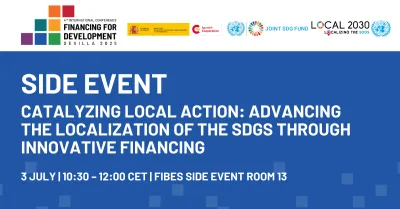
Catalyzing Local Action: Advancing the Localization of the SDGs through Innovative Financing
On 3 July 2025, the Government of Spain, the United Nations Joint SDG Fund and the UN Local2030 Coalition will co-host a side event, "Catalyzing Local Action: Advancing the Localization of the SDGs through Innovative Financing," at the Fourth International Conference on Financing for Development (FFD4).BackgroundAs the 2030 Agenda deadline approaches, achieving the Sustainable Development Goals (SDGs) demands more than national strategies — it requires bringing the SDGs to life with solutions emanating from the territorial level, where people’s needs, priorities, and ambitions take root and are best identified. Cities and territories are where sustainable development succeeds or fails.The Government of Spain, host country of the FFD4 Conference, is championing multilateralism and the localization of SDGs both at the national and local levels and in global Fora. As such, it is hosting the Local2030 Coalition, the UN system-wide platform for the localization of the Agenda 2030, and supporting the Joint SDG Fund, which drives systemic transformation toward the Sustainable Development Goals (SDGs) through integrated programming focused on identifying and supporting innovative policies and financing solutions. Spain is also supporting politically, technically, and financially efforts to localize development finance, through the elaboration and promotion of approaches and tools to support the localization of sustainable development at all levels.Building on the principles of the Bilbao Blueprint — jointly developed by the UN Joint SDG Fund, Local2030 Coalition and Basque Government — this session, convened by the Spanish Cooperation, will showcase how a whole-of-UN work with innovative and inclusive financing approaches can be systematically channeled to empower local systems to deliver transformative, measurable impact.The discussion will be situated within the global financing for development reform efforts under FfD4, and the growing call to facilitate and strengthen existing local capacities, governance, and access to finance to accelerate SDG implementation at the community level. This session will also serve as a launching pad for continuing efforts on localization post a successful Local Finance Design Sprint, that brought together in May a diverse group of experts and stakeholders from eight countries to co-create financing solutions for subnational food systems and green economy transformation. It continues to build a roadmap of action for the co-creation of bankable and scalable financing solutions grounded in country needs and territorial multi-stakeholder participated ecosystems. Click for the Concept Note -
Events
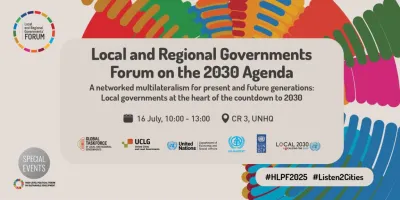
2025 Local and Regional Governments Forum on the 2030 Agenda
The Local and Regional Governments Forum(LRGF) at the 2025 High-level Political Forum will bring together local, regional, and national governments as well as representatives from the United Nations and other stakeholders to discuss how high-impact localization policies, partnerships, multilevel governance and financing can close the gap in the implementation of the Sustainable Development Goals (SDGs).Within this context, the Local and Regional Governments Forum, will highlight the interconnectedness between local action and collaborative multilevel governance as key drivers for SDG implementation. It will also underscore the need for a renewed, networked, and inclusive multilateral system—one that delivers for present and future generations by recognizing local and regional governments as political actors with a legitimate mandate from their communities, and meaningfully engaging them in intergovernmental processes and UN policy-making bodies.This LRGF will include a high-level briefing session on the process for the drafting of the SG’s Report on the Engagement on Local and Regional Governments, as mandated by Action 55 (e) of the Pact for the Future. The session will reflect on the existing mechanisms and opportunities for engagement of Local and Regional Governments within the UN system, followed by an open and horizontal exchangeAs part of the 2025 edition of the LRGF, a dedicated session will focus on the SDGs under review—namely SDG 3 (Health), SDG 5 (Gender Equality), SDG 8 (Decent Work), SDG 14 (Life Below Water), and SDG 17 (Partnerships) —highlighting their relevance to local and regional governments and centrality in accelerating the 2030 Agenda. Particular emphasis will be placed on the outcomes of the CSW69, the Beijing+30 process and the centrality of gender equality towards building a local social agenda ahead of theSecond World Summit for Social Development (WSSD2). The LRGF will delve into the Cities Countdown to 2030 and will feature practices and policies that are already mobilizing investments; impacting lives and accelerating transformative action.The LRGF will aim at featuring innovative advancements in local reporting and monitoring initiatives such as the VLRs and VSRs in connection to VNRs, as well as to foster multilevel governance and partnerships among different spheres of government, the international community and other stakeholders towards closing the gap on SDG implementation.The LRGF will also explore how local and regional governments can shape inclusive and innovative public services as levers for the rights and needs of future generations. Rooted in the Declaration on Future Generations, a dedicated session will explore how to advance sustainable development by 2030 and beyond, including in connection with the Fourth International Conference on Financing for Development, the WSSD2, and the United Nations Economic and Social Council, and HLPF review to be conducted by Member States during the 80th Session of the UN General Assembly.
HLPF Side Event: Localizing the SDGs
HLPF Side Event: Localizing the SDGs
Catalyzing Local Action: Advancing the Localization of the SDGs through Innovative Financing
2025 Local and Regional Governments Forum on the 2030 Agenda
Mainstreaming localization across global policy spheres
The Local2030 Coalition contributes to a wide range of international forums to mainstream localization across critical sectors. From climate action and sustainable finance to social development and urbanization, the Coalition ensures local priorities are represented at the United Nations Climate Change Conferences, the United Nations Ocean Conferences, the Financing for Development process, the World Summits for Social Development, and the World Urban Forums.
Concurrently, the Coalition collaborates closely with the European Union to embed localization within international cooperation frameworks. Through the EU-UN Policy Dialogues on SDG Localization, the Coalition brings together European institutions, United Nations entities, local and regional governments, and development partners to advance localized financing, strategic territorial development, and multilevel governance models worldwide.
-
Events
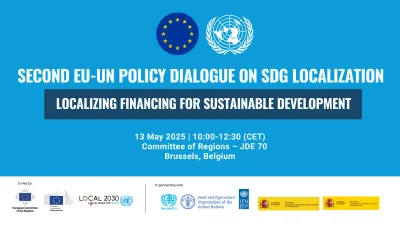
Second EU-UN Policy Dialogue on SDG Localization
Background The Sustainable Development Goals (SDGs) are the global blueprint for progress, and reaching them is a priority for both the European Union (EU) and the United Nations (UN). However, progress towards the SDGs is seriously lagging behind. To drive real impact, localizing the SDGs is increasingly recognised not only as a success factor of sustainable development to date but also as one of the key accelerators moving forward, inter alia by promoting a leading role for local and regional authorities (LRAs), to implement the 2030 agenda. In particular, LRAs are not only central to localizing and achieving nearly two-thirds of the SDGs but also possess the local knowledge, adaptability, and integration capacity needed to deliver results on the ground. This critical role of LRAs is gaining increasing recognition both at the EU and UN level. In the EU, the European Committee of the Regions (CoR) has long championed the role of LRAs in development cooperation, particularly through decentralised cooperation. The CoR has been working closely with the European Commission (especially the Directorate General for International Partnerships, DG INTPA) on this topic. The European Parliament but also the European Investment Bank are championing the SDGs as the reference framework for international cooperation, which has also been confirmed by the Council of the EU in successive conclusions of its Working Party on Agenda 2030. Similarly, the UN has recognized SDG Localization as a key driver of progress and as an accelerator of the implementation of the 2030 agenda on the ground. For instance, within the Pact for the Future adopted at the UN Summit of the Future, SDG Localization is referenced as key lever to leave no one and no place behind while engagement with LRAs on the 2030 Agenda is considered an entry point to further follow up on. SDG Localization is also considered one of the high impact initiatives to accelerate progress on the six SDG transitions through the Local2030 Coalition, emphasizing how these transitions can be scaled through catalytic investments, supportive policies, and multi-stakeholder partnerships. This convergence of views and actions on SDG localization materialized in the first EU-UN Policy Dialogue on SDG localization on 4 June 2024, gathering CoR members, European Commission and UN Directors, Member States and development bank representatives. The dialogue identified key messages on localization ahead of the 2024 HLPF and the UN Summit of the Future, as well as a roadmap for cooperation potentials focused on disseminating key messages and joint advocacy, engaging in capacity building exercises, and fostering joint training programs, among others. This roadmap included the Fourth Financing for Development Conference as one of the key milestones to advance SDG localization on the global agenda in 2025, particularly with regard to localized finance. Indeed, the issue of financing localization remains one of the key challenges to achieving the 2030 Agenda. This has been documented by LRA within the EU and is even more acute at the international level. Lack of access to finances is directly hampering the catalyst potential of LRAs to drive impactful changes and to provide public services. The reasons for these challenges are well known: the financial ecosystem is not conducive to supporting LRAs investments in local development, limited fiscal decentralisation and the capacity of LRAs are limited in many partner countries. At the international level, the decrease of Overseas Development Assistance (ODA) budget in key member states coupled with efforts to mobilize the private sector and use of blending or guarantee instruments is taking development assistance and development finance further out of reach for many LRAs. Although the 2015 Addis Ababa Action Agenda (AAAA) acknowledged the critical role of LRAs in its point 34, discussions ahead of FfD4 risk downplaying this importance. Rolling back on LRA financing would not only undermine the AAAA’s commitments but also contradict the Pact for the Future, which reaffirmed LRAs as essential drivers of sustainable development. Despite the challenges, actionable policy solutions exist. Supportto fiscal decentralisation, capacity building to access diverse financing mechanisms, specific city financing windows of development banks, or integrated local financing solutions have all been tested in practice. The next step is to share, consolidate and scale them up as well as to integrate them into global policymaking, ensuring that solutions are designed and implemented at the most effective and appropriate level of governance Objectives The second edition of the EU-UN Policy Dialogue aims to capitalize on the momentum built in 2024 and further strengthen the EU and UN common goal to: Advocate for increased access of LRAs to development finance Position localized financing as key to accelerate SDG implementation Define concrete policy solutions to champion at FfD4. This edition of the dialogue is a key milestone in the "Road to Seville: the Local Way" engagement strategy fostered by the United Nations Local2030 Coalition to elevate local finance as a priority ahead of FfD4. More specifically, the dialogue will be a stepping stone to consolidate positions in between the World Forum on Local Economic Development and FfD4. The UN-EU Policy Dialogue will therefore gather key senior officials/representatives from the EU and the UN with the objectives of strengthening the case related to SDG localization and local finance, focusing on how these institutions can partner to leverage access to financing to European and international political leaderships. Members of the European Parliament, representatives of Development Banks and Member States, including the Polish Council Presidency, will be involved in linking the event to their ongoing efforts on the issue. The dialogue will do so by: jointly taking stock of the progress and challenges of both the EU and the UN related to localizing financing for the SDGs. identifying key policy messages and technical cooperation opportunities for the EU and UN to foster the financing of SDG localization and feed into the upcoming UN events, in particular FfD4, and other strategic processes The tangible output of the dialogue will be a i) set of key messages and recommendations that can be used by each participating institution, and potentially presented at FfD4 and brought into other global processes on financing and ii) propositions for further joint actions. Follow the event online. -
Events
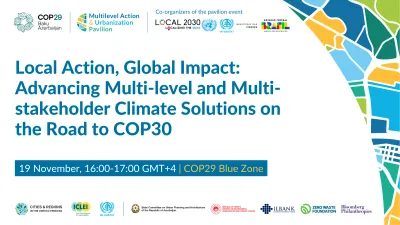
Local Action, Global Impact: Advancing Multi-level and Multi-stakeholder Climate Solutions on the Road to COP30
In the wake of rising inequalities, climate change and the multiple crises facing our world today, governments at all levels, stakeholders and communities are taking action at the local level to ensure that no one and no place is left behind and that people and the planet are protected. The 2024 SDG Report shows only 17% of the Sustainable Development Goals’ targets are on track, with 30% seeing minimal progress and over 30% stalled or regressing. As global efforts continue to accelerate the achievement of the SDGs, there is an increasing emphasis on the power of localizing the SDGs, ensuring their implementation comes from the ground up and is rooted in community-led efforts. This involves tailoring the goals to local contexts and ensuring that local and regional governments, stakeholders from all sectors and local communities are actively engaged in the implementation process of the 2030 Agenda. 2024 and 2025 mark pivotal moments for advancing the localization of the SDGs and climate agenda. Key milestones, such as COP29 in Baku, Azerbaijan, and COP30 in Belém, Brazil, offer unique opportunities to accelerate climate action through multi-level governance and multi-stakeholder collaboration. These events build on the momentum generated by the Summit of the Future, the World Urban Forum, and the G20 Brazil Summit, all of which have called for a revitalized, more inclusive multilateral system and reform of the global financial architecture. To scale up the impact of COP29 and COP30 and ensure it is part and parcel of the UN’s broader SDG localization agenda and that its outcomes feed into the implementation process of the SDGs, it is essential that it be interconnected to the other main advocacy milestones linked to the SDGs taking place in the lead-up to COP30. As the UN platform that supports the on-the-ground delivery of the SDGs, acting as a convergence point between local and regional governments and their associations, national governments, businesses, community-based organizations and other local actors, and the United Nations system, the Local2030 Coalition has a unique role to play in this regard, ensuring that UN initiatives at COP29 and COP30 feed into the overall multilateral development agenda. Within this context, the Local2030 Coalition, UN-Habitat and the Ministry of Cities of Brazil, will co-organize a side event at the COP29 Multi-level Action and Urbanization Pavilion facilitated by UN-Habitat and the LGMA Constituency aiming to bring together representatives from different levels of governance and from different sectors to discuss i) how an effective multi-level and multi-stakeholder roadmap in 2025 can contribute towards a successful COP30; and ii) explore what mechanisms need to be put in place to ensure that strategies for developing, implementing, and following up on Nationally Determined Contributions (NDCs) are ambitious, rooted in communities, and guided by SDG localization. Particular emphasis will be placed on how multi-level and multi-stakeholder cooperation can accelerate the implementation of the Paris Agreement while achieving the SDGs. The event will share best practices from a UN system-wide perspective, from national and local government representatives that will offer a strategic opportunity for participants to discuss synergies and scale up efforts from COP29 to COP30 and beyond. The meeting will ensure a link between COP29, COP30 and the High Impact Initiative on SDG Localization as well as the localization of the six SDG transitions. Objectives Illustrate concrete examples of local-level policies and initiatives leading to more impactful climate action that are multi-level and multi-stakeholder in nature, spotlighting specific initiatives such as CHAMP. Scale up actions that can have multiplier effects and that accelerate the implementation of the SDGs through the lens of the six SDG transitions and that consider key climate issues such as Nationally Determined Contributions, youth empowerment, climate and gender equality, and sustainable oceans, among others. Foster dialogue on the follow-up to COP29 and the role of multistakeholder collaboration in SDG localization with a particular focus on increasing capacities and financing at the local level in preparation for FFD4 and COP30. Expected outcomes Demonstrate models and initiatives that illustrate effective collaboration among stakeholders, inspiring concrete commitments and partnerships for climate action. Generate actionable recommendations and commitments from stakeholders to enhance local capacities and secure sustainable financing for the development of NDCs that are guided by SDG localization. Develop follow-up strategies towards COP30. Participants Member States, local and regional governments and their networks, the private sector, academia and UN entities. -
Events
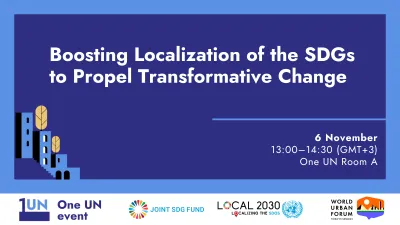
Boosting Localization of the SDGs to Propel Transformative Change: Side Event at the Twelfth Session of the World Urban Forum
As our world grapples with unprecedented challenges, exposing our fragile systems and threatening progress towards the 2030 Agenda, achieving the SDGs requires integrated and cross-sectoral actions. The SDG transitions framework was introduced to promote more inte-grated solutions in order to transform systems related to climate, food, energy, jobs, social protection, education, and digital connectivity. The crises of our time facing people and planet all have local dimensions, putting additional pressure on prompt and effective local action that ensure no one and no place is left behind. Therefore, localizing the SDGs brings opportunities for shaping responses and planning through innovative, collective, and coordinated pathways for sustainable development close to where people live. As the United Nations Secretary General remarked during the launch of the Advisory Board on Local and Regional governments in October 2023, the SDGs are eminently local and multi-level cooperation is vital to rescue the SDGs, with speed, scale and coordination. The Joint SDG Fund (the Fund) is the UN flagship global fund to supercharge the UN Development System to be fit for purpose and to catalyze systemic transitions in areas of cross-sectoral and cross-organisational integrated policy and financing to accelerate the SDGs. The Fund has already invested around USD 79 million supporting actions for localizing the SDGs. This includ-ed initiatives that worked with neighborhoods, villages, municipalities, districts and more on innovative policy solutions as well as on adopting local approaches and developing financial solutions to mobilize capital for the local level. The Fund recognizes SDG localization as a key pillar of its new strategic approach and a pivotal driver behind all key SDG transitions. None of the six SDG transitions can have its requisite impact without landing at the local level, and this framework ensures that the Fund’s investments lead to tangible transformative outcomes driv-ing local impact. The Local2030 Coalition is the UN System-wide platform and network for supporting and accelerating the localization of the 2030 Agenda for Sustainable Development. The Coalition brings together the UN, local and regional governments and their associations, national governments, businesses, community-based organizations, and other local actors to mobilize, empower and support local stakeholders in advancing the 2030 Agenda for Sustainable Development. Through the Local2030 Coalition, 14 UN entities are unified around the need to understand and scale up localization action and financing. The Joint SDG Fund and the Local2030 Coalition joined forces and launched in March 2024 a dedicated funding round focused on supporting catalytic initiatives in 30 countries that can clearly demonstrate the role of SDG localization in accelerating the key transitions for the SDGs. Moreover, the Fund and the Local 2030 Coalition have jointly developed a SDG Localiza-tion Marker to identify initiatives that effectively prioritize localization efforts, ensuring both pol-icy coherence and transparent and accountable tracking of allocated financing for SDG locali-zation, and facilitating rigorous monitoring and reporting on the progress achieved in localizing the SDGs. The event will convene diverse partners and frame the conversation around the role of the Joint SDG Fund and Local 2030 Coalition in supporting national, regional and local governments overcome impediments to financing and advancing the SDGs at the local level. The event will build on the practical local solutions of three countries, will showcase Spain’s leadership of the SDG Localization agenda and highlight USAID’s best practices to further enrich the conver-sation with a different perspective. Key Objectives: Promoting Integrated and Cross-Sectoral Actions at the local level: Highlight the importance of integrated solutions tailored to the local dimensions and the importance of prompt and effective local action to ensure inclusivity and leave no one behind. Advancing SDG Localization: Showcase success stories for shaping responses and planning through innovative, collective, and coordinated action for sustainable development at the local level. Highlighting Multi-level Cooperation: Stress the significance of multi-level cooperation in rescuing and accelerating progress towards the SDGs. Leveraging the United Nations system: Illustrate the role of the United Nations Joint SDG Fund and Local 2030 Coalition in catalyzing systemic transitions at the country level, with a focus on supporting SDG localization efforts through policy and financing initiatives. Overall, the event aims to convene partners to discuss and strategize on overcoming impediments to financing and advancing the SDGs at the local level and drawing insights from successful initiatives and partners worldwide. Supporters United Nations Joint SDG Fund Local2030 Coalition
Second EU-UN Policy Dialogue on SDG Localization
Local Action, Global Impact: Advancing Multi-level and Multi-stakeholder Climate Solutions on the Road to COP30
Boosting Localization of the SDGs to Propel Transformative Change: Side Event at the Twelfth Session of the World Urban Forum
From dialogue to delivery: Building capacity for SDG localization
Empowering local actors requires more than participation in policy discussions: it requires the practical capacity to turn global commitments and national priorities into coherent territorial action. Through the Localization Blueprint, the SDG Localization Marker 2.0, tailored curricula, peer learning and Design Sprint and Bootcamp methodologies, the Coalition and its partners support Resident Coordinators and United Nations Country Teams, national and subnational governments and other local actors to assess enabling conditions, co-design integrated programmes, strengthen multilevel governance and develop finance-ready territorial solutions.
This approach connects training with real country programming, financing and follow-up, enabling participants to apply the tools in their own contexts and share learning across countries and territories.
-
Library
SDG Localization Marker
LibrarySDG Localization Marker
The SDG Localization Marker was developed through a collaborative process led by the Joint SDG Fund and the Local2030 Coalition, with contributions from representatives of international and regional organizations, national and local and regional governments, civil society, academia, youth organizations, and the private sector. These stakeholders shared their expertise and perspectives throughout the consultation, review, and validation process. The Joint SDG Fund and the Local2030 Coalition also wish to acknowledge the valuable support of the Government of Spain in developing the SDG Localization Marker. They further extend their appreciation to the United Nations entities that are members of the Local2030 Coalition— DCO, FAO, ILO, IOM, UN DESA, UN Women, UN-Habitat, UNDP, UNEP, UNFPA, UNHCR, UNICEF, WHO, and the UN Regional Economic Commissions—as well as to the Coalition's partners, for their technical guidance, coordination support, and editorial contributions throughout the development process. -
Library
The Localization Blueprint: Enabling Environments to Channel Finance towards Local Impact
The Localization Blueprint provides practical pathways for local and regional governments, financial institutions, development partners, the private sector, civil society, and knowledge actors to co-create an enabling environment to mobilize, align, and channel finance directly toward local SDG and humanitarian development priorities. It clarifies how each stakeholder can contribute to a coherent, efficient, and action-oriented local development process to ensure resources flow efficiently to communities, multiply impact, and accelerate SDG localization, leaving no one behind. It serves as a shared framework to transform local priorities into investable pipelines and accelerate inclusive and scalable territorial transformation. -
Library
Bilbao Bootcamp II: Scaling and Building Investable Territorial Solutions through the Localization Blueprint and the Marker 2.0
The Second Edition of the Bilbao Blueprint Bootcamp evolved into a global convening, designed to inspire, connect, and equip a broader coalition of stakeholders. With a focus on local financing solutions for the SDG transitions, the 2026 edition integrated inspiring sessions with thought leaders, thematic roundtables, and technical design workshops led by practitioners to foster bold thinking, practical innovation, and investment matchmaking.The Bootcamp supported the piloting of territorial transformation solutions in selected countries, with the explicit objective of informing national public policy frameworks and replication across territories. By linking subnational innovation with national reform and global agendas, the initiative aimed to catalyze systemic change that accumulates from the local to the global level. The objective was not merely to finance projects, but to demonstrate how territorially anchored financing solutions can reshape governance systems, inform national reform, and collectively drive global sustainable development. -
Library
Bilbao Bootcamp II. From Territorial Priorities to Financing Pathways:Strategic Outcomes Report
LibraryBilbao Bootcamp II. From Territorial Priorities to Financing Pathways:Strategic Outcomes Report
The Bilbao Bootcamp II exemplified how United Nations country teams, Resident Coordinator Offices, host governments and financing partners can deliver co-created, bankable local initiatives, directly operationalizing the Seville Platform for Action on Localizing Finance and establishing an evidence-based roadmap leading to the 2027 SDG Summit. Ultimately, the central lesson from the event is that localization is an active delivery agenda where financing must respond directly to territorial priorities. This transformation hinges on strong country ownership, effective multilevel governance, coherent United Nations support and early engagement across public, private and development finance partners.